

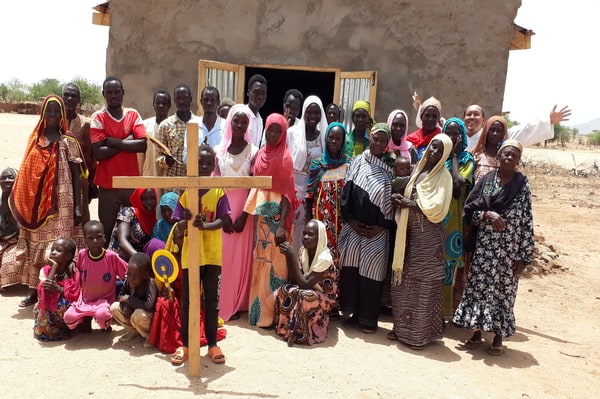
Aid to the Church in Need – Bishop Philippe Abbo Chen is the first native head of the Apostolic Vicariate of Mongo in eastern Chad. During a recent visit to the international headquarters of Aid to the Church in Need (ACN), he described a territory in the heart of the Sahara Desert, where the majority is Muslim, but the Christian community plays an important missionary role.
The Apostolic Vicariate of Mongo includes a large desert. Is this an atypical region?
Our vicariate covers the eastern half of Chad, which is more than 90,000 square miles, about the size of France! About 1.7 million people live here; since the land is arid, the population is relatively small. Muslims are the majority here, and there are only just over 15,000 Christians. And despite being a region with few resources, it has taken in a great number of refugees from Sudan.
How has the war in Sudan affected you?
Over 100,000 refugees have moved into the vicariate. Most of them are children, women, and the elderly with no resources. We are doing what we can to help them, but we are limited. And we have our own age-old conflicts with farmers and pastoral nomads.
What sort of conflict is there between the farmers and nomads?
In most cases, we are talking about herds from the north that roam freely over cultivated southern land. The fields have no fences, so the animals end up damaging the crops. When the farmer confronts the herder, things often escalate. Then everybody calls a brother or a cousin, and the argument turns into a fight!
Unfortunately, many of the nomads are well armed. In late August, I was called to the site of one of these conflicts, in Mangalmé, 60 miles from Mongo. A man tried to get two oxen off his field, and it became a major fight with knives. Ten people were killed.
As a bishop, why are you called to intervene in such a dispute?
Both the attackers and the victims were Muslim, but in our region, there is great respect for religious leaders. I was asked to go there as a man of God, and I was able to meet with the victims. As always, the attackers had vanished into the desert. Unfortunately, this type of violence has only increased over time.
What do you think has caused the increase in violence?
There are many factors. On the one hand, the desert is increasing, and the pastoral lands are diminishing. The population of Chad is also increasing, which leads to struggles over resources, made worse by the proliferation of firearms. The simplest argument can escalate very quickly when AK-47s are involved! Finally, the Chadian state has had a crisis of authority since the death of President Idriss Déby in April 2021. We are concerned about the future of the country. The education system is falling apart, and food prices have tripled. In this context, our Church isa refuge.
Are Christians discriminated for their faith?
Sometimes our parishioners tell us that they are afraid to show their faith in certain environments. Generally, though, we are perfectly free to practice Christianity. We can ring our church bells and hold processions in the streets.
However, over the past few years, we have had some problems with young imams who return from training in Sudan and subscribe to a narrower view of Islam. They refuse fraternal relations with members of other religions, and this could turn into a long-term problem.
Finally, conversions are often badly received by the family of the convert. One of my brothers converted to Islam, and I have a good relationship with him, but it’s not always easy. In my country, people do not exist as individuals; they exist as part of a group. That is why a more individualized approach to religion generally doesn’t go well, especially when it is a Muslim converting to Christianity. This year, we had three cases of violence in families of converts who ended up not being baptized.
But despite these difficulties, you are about to ordain two new priests for the vicariate. This is impressive for a community of 15,000! How do you explain new vocations in a challenging environment?
We have a vibrant Church! The cathedral of Mongo, which was built less than a decade ago, is already too small to host all our faithful, which is why we must have several Sunday Masses. We have hundreds of baptisms every year. Our community is a small minority in a vast territory, but it has a unique evangelizing mission.
And I would also like to use this interview to thank Aid to the Church in Need, which helped cover the educational costs of our two seminarians.
—Sylvain Dorient
