
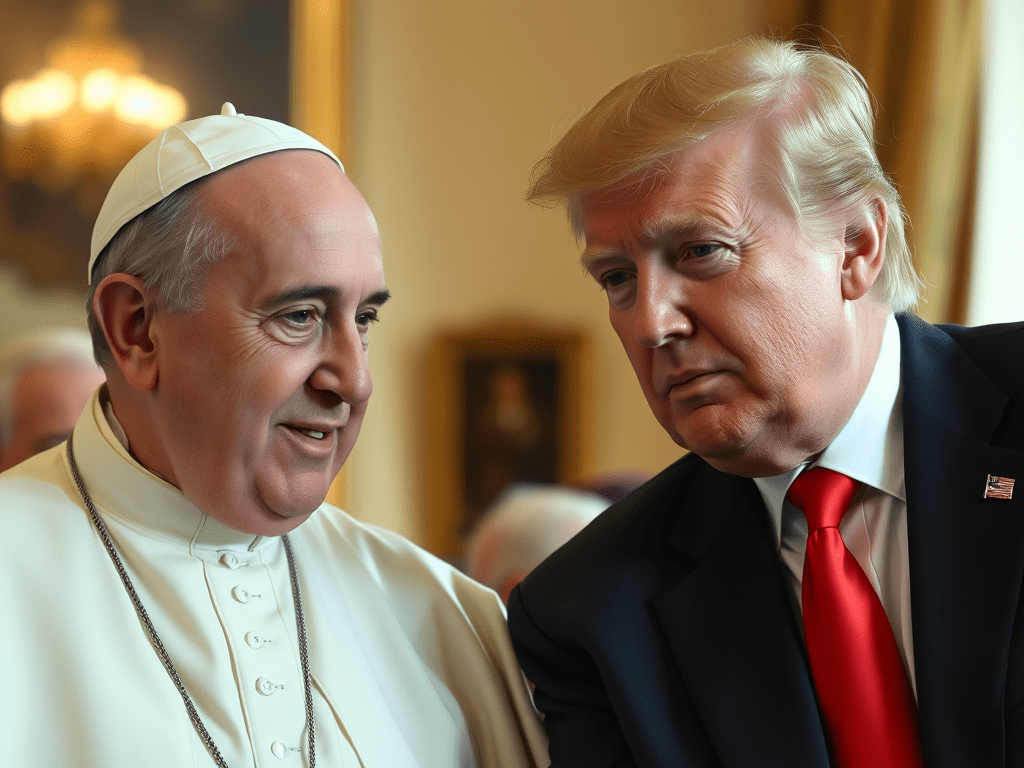
Author: Lisa Graas, assisted by Grok.
In an ironic twist that has not gone unnoticed, the Vatican City State has recently tightened its own border policies, imposing stringent sanctions on those attempting illegal entry into its sacred territory. This move has sparked a conversation about hypocrisy, particularly in light of the vocal criticisms leveled against former U.S. President Donald Trump’s stringent immigration policies.
The Vatican, known for its moral leadership and advocacy for the marginalized, has now set fines ranging from 10,000 to 25,000 euros and prison sentences from one to four years for those who illegally enter its territory. This includes measures against those who use violence, threats, or deception to bypass security systems. Such actions are a stark contrast to the open-door narrative often associated with Catholic teachings on migration.
President Trump, during his tenure, implemented policies aimed at securing the U.S. southern border, including the construction of a wall, ending catch-and-release practices, and enforcing strict immigration laws. These actions were met with significant backlash from various quarters, including religious leaders who invoked moral and humanitarian arguments against such measures. Pope Francis himself was notably critical, describing Trump’s approach to immigration as “not Christian.”
However, the Vatican’s recent policy adjustments raise questions about consistency in moral leadership:
- Security vs. Open Borders: The Vatican, like any sovereign state, acknowledges the necessity of border security to protect its citizens and its integrity. This mirrors the rationale behind Trump’s policies which emphasized national security and legal immigration pathways. Critics of Trump often portrayed his actions as harsh or inhumane, yet the Vatican’s similar approach suggests a shared understanding of the need for controlled borders.
- Selective Application of Principles: While promoting a welcoming attitude towards migrants globally, the Vatican’s enforcement of its own borders highlights a selective application of principles. If the Vatican can justify controlling its entry for reasons of security and order, why is the same justification not extended to other nations like the U.S. when they seek to protect their borders?
- Moral Authority and Practicality: The criticism of Trump’s policies often came from a moral high ground, emphasizing compassion and the Christian duty to welcome the stranger. However, the Vatican’s actions demonstrate that even those who preach such values see the practical necessity of border enforcement when it comes to their own territory.
- Public Perception and Double Standards: Posts on X and various web articles have pointed out this apparent double standard, with some users likening the Vatican’s walls to Trump’s border wall. The Pope’s criticism of Trump’s policies while maintaining a heavily guarded Vatican has been seen by some as a case of “do as I say, not as I do,” undermining the moral authority of such critiques.
The Vatican’s border policy serves as an interesting case study in the complex relationship between moral imperatives and practical governance. It underscores that while ideals of openness and hospitality are noble, the realities of security, sovereignty, and order often necessitate a more nuanced approach. This scenario invites a broader discussion on how nations balance humanitarian values with the legitimate need to secure their borders, questioning whether the criticisms of Trump’s policies were indeed fair or perhaps laden with political bias rather than moral consistency.
In conclusion, while the Vatican’s stance on immigration has historically been one of welcome, its recent actions suggest that even in the Holy See, the principles of security and legality hold significant weight. This development might prompt a reevaluation of the criticisms against Trump’s policies, urging a more balanced discourse that recognizes the complexities of immigration and border control in the modern world.
