

Image: Public Domain
Author: Lisa Graas, assisted by Grok.
Apostolic succession is a fundamental concept in the Catholic Church, underpinning the continuity, authority, and sacramental life of the Church from its founding by Jesus Christ to the present day. This doctrine asserts that the bishops of the Church today are the successors of the apostles, maintaining an unbroken chain of ordination and authority from the apostles themselves. Here, we explore this doctrine through the lens of Sacred Scripture.
The Establishment by Jesus Christ
The origin of apostolic succession can be traced back to the words and actions of Jesus Christ. In the Gospel of Matthew, Jesus explicitly gives authority to the apostles:
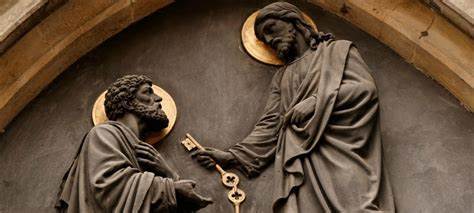
- Matthew 16:18-19: “And I tell you, you are Peter, and on this rock, I will build my church, and the gates of Hades will not prevail against it. I will give you the keys of the kingdom of heaven, and whatever you bind on earth will be bound in heaven, and whatever you loose on earth will be loosed in heaven.” This passage is pivotal, as it establishes Peter as the first among the apostles, with a unique role in leadership. It is the foundation of the papacy.
- Matthew 28:19-20: “Go therefore and make disciples of all nations, baptizing them in the name of the Father and of the Son and of the Holy Spirit, teaching them to observe all that I have commanded you.” Here, Jesus commissions the apostles to spread His teachings and to continue His mission, which implies an ongoing mission that would need to be passed on.
Continuity through the Apostles
The apostles themselves understood their role as one that would continue beyond their lifetimes:
- Acts 1:20-26: After Judas Iscariot’s betrayal and death, the remaining apostles felt the need to choose a successor who had been with them from the beginning. Matthias was selected to take his place, indicating the importance of maintaining apostolic continuity.
- Acts 6:6: The laying on of hands, a practice still used in ordinations, signifies the transmission of this apostolic authority. Here, the apostles ordained deacons, showing the early practice of passing on roles and responsibilities.
- Acts 14:23: “And when they had appointed elders for them in every church, with prayer and fasting, they committed them to the Lord in whom they had believed.” Paul and Barnabas appointed leaders in the churches, ensuring that each community had shepherds under apostolic oversight.
Scriptural Assurance of Succession
The writings of the New Testament suggest that this succession was not just about maintaining numbers but was integral to the continuity of teaching and authority:
- 1 Timothy 4:14: “Do not neglect the gift you have, which was given you by prophecy when the council of elders laid their hands on you.” Here, Paul reminds Timothy of his ordination, linking it to the gifts and responsibilities passed on by the laying on of hands.
- 2 Timothy 2:2: “And what you have heard from me before many witnesses entrust to faithful men who will be able to teach others also.” This instruction from Paul to Timothy clearly envisions a chain of teaching and authority.
Apostolic succession is thus not just a historical event but a living reality in the Catholic Church founded by Christ. It ensures that the Church remains rooted in the teachings of Christ through the apostles, guarantees the valid celebration of the sacraments, and provides a structure for governance and pastoral care. By continuing the apostolic mission, the Church maintains unity with the original faith, doctrine, and ministry established by Jesus Christ, as seen through the lens of Scripture. This succession is a testament to the enduring presence of Christ in His Church, guiding it through time until His return.
