

AID TO THE CHURCH IN NEED. Published with permission.
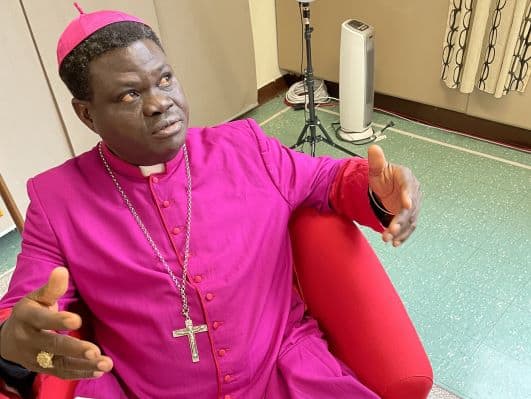
THE BISHOP HAS AN EASY, infectious laugh. He is kind and attentive to the people he meets. But on a recent mission to visit the halls of the US government, his purpose was dead serious.
Bishop Wilfred Anagbe, the leader of the Diocese of Makurdi in Nigeria’s Benue State, in the so-called Middle Belt, came to the US as a guest of Aid to the Church in Need-US. He was given the opportunity to tell the story of his people’s suffering at the hands of Islamist Fulani herdsmen out to kill Christian farmers who have long thrived thanks to the region’s famously fertile land. But for these farmers, life has become a nightmare now almost in its second decade, as herdsmen relentlessly stage deadly attacks that have killed thousands since 2014.
The attacks often come in the middle of the night, with victims the most defenseless. Just last Holy Saturday, a Fulani herdsmen attack killed almost 40 people. Since spring 2022, there have been 140 attacks in Benue State and some 590 people have died. This was the distressing message the bishop delivered as he met with US political leaders and journalists.
What particularly angers and saddens him is the glaring fact that the Nigerian government has not brought a single perpetrator of terror to justice, nor has a ranking official ever visited the bishop. The government has not given any aid to the many thousands of survivors, who as Internally Displaced People—numbering between 1.5 and 2 million—live in squalor in camps, several of which are overseen by the diocese.
In every meeting and during every interview, the bishop exudes a sense of outrage and anger as he recounts the story of his people’s suffering and the government’s failure to protect them. He also reports on the painful reality that the Fulani herdsmen have taken over territory, occupying villages, and farmland whose residents have fled. In the process, the Diocese of Makurdi has lost 13 parishes, each including at least a dozen or so out stations, comprising areas as large as 10 square miles.
Bishop Anagbe was accompanied on his visit by Father Remigius Ihyula, his right-hand man, who oversees the diocese’s humanitarian efforts to help the IDPs. The pair make a powerful impression, with the bishop wearing a red-purple tunic and Father Remy clad in a full-length black cassock. Walking the hallways of the buildings housing the offices of Members of Congress, the pair drew respectful attention. It was clear that they were there on important business.
They carried a powerful piece of evidence, a video produced by Father Remy that captured the heartbreaking emotions of women who lost family members and very difficult-to-watch images of brutalized corpses in a makeshift morgue, laying in the open. That video proved a powerful tool in conveying the anguish of the people of Benue State and the urgency that something is done.
The US government clearly has an important role to play. There are efforts taking place to re-designate Nigeria as a Country of Particular Concern given the Islamist persecution of Christian farmers, and to appoint a Special Envoy to Nigeria or the Lake Chad Region to put a spotlight on the horrors of deadly Fulani terror and other forms of anti-Christian violence.
These measures would force the US government into action and bring pressure to bear on the Nigerian government to slow the violence. As things stand, the US Embassy in Nigeria has not taken notice of the situation in Benue. An envoy would be able to prod the State Department.
Four Congressmen who met with Bishop Anagbe and Father Remy—and who were deeply moved by the video—expressed a commitment to help. Congressman Chris Smith (R-NJ) is considering holding a hearing in the House on Nigeria, come the fall. If that happens, Bishop Anagbe may be back in Washington to give testimony.
The initiative to hold such a hearing will be aided by the pledged support of Congressman Michael McCaul (R-TX), chairman of the House Committee on Foreign Affairs. Congressman Andy Harris (R-MD) offered the idea of including action on Nigeria as part of an upcoming Appropriations Bill. Finally, Rep. French Hill (R-AK) announced that he would visit Makurdi sometime this fall.
Thankful for these significant prospects, the bishop and Father have returned home to confront the bleak reality of the Diocese of Makurdi, dealing with the situation on their own, far away from the US Congress.
Remarkably, Bishop Anagbe kept stressing that he is convinced that the power of faith will eventually prevail. He also insisted that the blood of the martyrs is the seed of the Church. Both the bishop and Father Remy clearly do not fall prey to pessimism, even in the face of such grave difficulties.
Not a day in their company passed without strong expressions of gratitude and hearty laughter. They are two remarkable men of the Church and two remarkable representatives of their people.
