
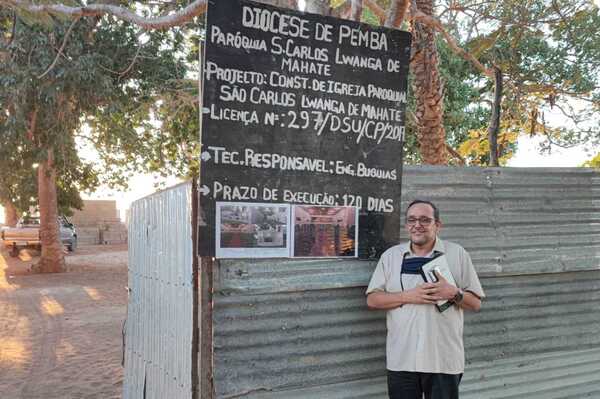
The Catholic Church has played a discreet but important role in dialogue that could end terrorist violence in northern Mozambique, said Father Eduardo Roca, a project partner of Aid to the Church in Need. In 2017, Father Roca founded the Interreligious Center for Peace in the Diocese of Pemba. That same year, terrorist attacks began in Cabo Delgado.
“The Catholic Church is not only concerned; it is engaged and seriously committed to doing whatever it can for the peace negotiations,” said the priest, who has been based in Mahate, in the Diocese of Pemba, since 2012. This commitment exists “at the religious level, but also at the academic level and among the local communities.”
The priest’s words come at a time when new attempts are being made to put an end to armed violence. The Church is in a privileged position to aid this dialogue, due to its presence on the ground and contact with even the smallest and most distant communities. “We are encouraging parish priests to create interreligious groups, and we are providing training in all the northern districts to promote interreligious dialogue and create bridges for people to meet and talk to each other in safety,” Father Roca explained.
A number of events are already planned for the coming months. “In the second half of July, and then in August and September, we will have meetings in Palma, Mocímboa da Praia, and Macomia with some 50 leaders of Muslim and Christian organizations, to study and promote the ‘Document on Human Fraternity for World Peace and Living Together,’ signed by Pope Francis and the Grand Imam of Al-Azhar in Abu Dhabi,”says the parish priest.
Mahate is, in many ways, ground zero for this effort. The impoverished slum, which stretches along a dusty road, is the center of Islam in the city of Pemba and saw the creation of the movement which led to the Islamist insurgency that turned nearly all of Cabo Delgado into a war zone. Few people know this place as well as Father Roca, who told ACN about the need to “work with the local communities to help deradicalize mindsets,” adding that “there is a mindset which has spread among the local leaders, and which introduced these violent ideas that have been linked to Islam. We are working to try and counter this.”
The Church’s involvement in a peace process for Cabo Delgado was heralded by a pastoral note issued by the Bishops of Mozambique in November of 2022, which highlighted the need for dialogue, rather than armed force, to end terrorism in the country. “We should all join forces to find solutions for this disgrace, rather than trust only in military force. We would like to remind all those involved in this war of the words of Pope Francis: ‘the God of peace never brings about war, never incites hatred, never supports violence. We who believe in him are called to promote peace with tools of peace, such as encounter, patient negotiations, and dialogue, which are the oxygen of peaceful coexistence.’”
The insurgency that has spread fear and death in Mozambique, especially in the provinces of Cabo Delgado, Niassa, and Nampula, began in October 2017 and has killed more than 4,000 people, as well as creating about 1 million internally displaced persons (IDPs).
ACN has aided the Church in Mozambique, primarily through pastoral assistance and psychological and social projects, but also through the construction of community centers and the purchase of vehicles for missionaries working with IDPs. ACN will also grant a scholarship to a local priest, to prepare him as an advisor of the Church on issues related to Islam and interreligious dialogue.
—Paulo Aido, Aid to the Church in Need. Published with permission.
PHOTO: Father Eduardo
